ILM sent me to the AWS re:Invent conference in Las Vegas this year. It was interesting for a number of reasons, but I did feel as though I were being pitched something quite a lot of the time, if I hadn't already drunk the AWS kool-aid that is. I'm pretty sold on the value-add of this service (for example, I use it for most of my new web projects already and will be transitioning old projects off of Linode soon).
I think it's brilliant of Amazon to have found a way to subsidize the infrastructure of their core business (i.e. amazon.com). There were presentations from many SMBs, but the largest were probably Netflix and Yelp. It's just a matter of time before the ROI for enterprise level clients makes it feasible to move everything to AWS, or possibly a competing service from IBM, Google or Rackspace. Walking around the expo space, it's clear a whole new industry around cloud-based services and monitoring is also emerging.
Here are some slides that cover some of the things I learned while there:
Wednesday, November 20, 2013
Wednesday, July 24, 2013
SIGGRAPH 2013 & Alembic 1.5
ILM sent me down to SIGGRAPH this year in Anaheim since I've been one of the software developers on the Alembic project.
Practical Acceleration of Alembic
Birds of a Feather
WEDNESDAY, JULY 24, 2013 - 11:00AM TO 12:00PM
For SIGGRAPH, we released Alembic 1.5, with the new faster Ogawa backend. For my part, I got to speak a bit about some of the tools I've been working on for Alembic:

AbcView is a graphical PyQt-based Alembic inspection and visualization tool. It offers a number of widgets to help you inspect and visualize your Alembic data, as well as assemble hierarchical scenes.

Practical Acceleration of Alembic
Birds of a Feather
WEDNESDAY, JULY 24, 2013 - 11:00AM TO 12:00PM
For SIGGRAPH, we released Alembic 1.5, with the new faster Ogawa backend. For my part, I got to speak a bit about some of the tools I've been working on for Alembic:


Sunday, January 6, 2013
Utter
Looking for a basic text-to-speech (tts) Python module with language conversion and mp3 playback and comes with a Heroku web app? Try utter, https://github.com/rsgalloway/utter.
I've also written a simple Instapaper Python API, that when combined with utter, you can use to read saved articles back to you, for example on your commute or a road trip. You can even have it translated to another language if you want, for example Italian:

You can play with it here: http://utter.herokuapp.com. Sorry, Chrome only, and I've capped the language translation at 2M characters per day.
Disfrute!
% pip install utterIt's super easy to use from the command line:
% utter "this is a test"and to convert to, say, German:
% utter "I am a Berliner" -t deThe Python API is just a easy to use:
>>> import utterThe only requirement for translation is that you have a Google API Key, which you can get from the Google APIs Console.
>>> utter.play("I love utter", target="ja")
I've also written a simple Instapaper Python API, that when combined with utter, you can use to read saved articles back to you, for example on your commute or a road trip. You can even have it translated to another language if you want, for example Italian:
>>> import utterUtter also comes with a "web" branch that's ready to deploy to heroku. The nice thing about the web app is that it takes advantage of the built-in speach-to-text feature of Chrome, so you can get automatic spoken language translation on the fly. Just click on the language menu to choose the target language, then click the mic to start.
>>> for m in marks:
... utter.play(m.text, target="it")
Disfrute!
Sunday, August 5, 2012
PySeq 0.3.0
Finally released a new version of PySeq, the open-source compressed sequence string module for Python. The biggest change here is that it fixes issue #1, where same-named sequences but with different extensions were not being compressed, e.g.
% lss tests/fileA.*Change log:
3 fileA.%04d.jpg 1-3
3 fileA.%04d.png 1-3
+v0.3.0 - 2012 Aug 05Thanks to Erkan Ozgur Yilmaz for the %R directive fix in uncompress.
+ fixed %R in uncompress()
+ fixed minor bug in getSequences() with glob
+ fixed issue #1: same seqs with different extensions don't compress
+ added some simple inline unit tests
Friday, September 23, 2011
Skype For TV
I've been using Skype for a while now. At first for video conferencing, but now I use Skype (or gtalk) to make all of my phone calls since I said adiós to AT&T.
From the first time I ever used Skype, I wanted to use it from the living room on a large screen TV. Unfortunately, there weren't a lot of otb solutions for that at the time.

Now, you can purchase an expensive HD TV or Blu-ray player with Skype built-in, or become a Comcast customer and rent a set-top box from them. Or, every time I want to use Skype on my TV I could haul my laptop over and connect and disconnect cables and what-not. I think there is even a hack to make it work on an Apple TV. As far as I can tell, there's no equivalent hack for Roku or Boxee.
So I thought it'd probably be easy to just build an inexpensive prototype of a Skype set-top box using OEM parts, install Linux and write some software that uses the Skype API. Maybe there's even a niche market for one of those, so I put up a simple site to do some market research:SkypeForTV.com http://rsg.io/bO0HN.
UPDATE:
Skype sent me a C&D for the domain SkypeForTV.com (interesting how that domain redirects to bing.com now that MS bought Skype), so I moved the poll to here, however it looks like Skype had an even bigger reason for me to take down my poll, they were working on their own version of the set-top box.
From the first time I ever used Skype, I wanted to use it from the living room on a large screen TV. Unfortunately, there weren't a lot of otb solutions for that at the time.

So I thought it'd probably be easy to just build an inexpensive prototype of a Skype set-top box using OEM parts, install Linux and write some software that uses the Skype API. Maybe there's even a niche market for one of those, so I put up a simple site to do some market research:
UPDATE:
Skype sent me a C&D for the domain SkypeForTV.com (interesting how that domain redirects to bing.com now that MS bought Skype), so I moved the poll to here, however it looks like Skype had an even bigger reason for me to take down my poll, they were working on their own version of the set-top box.
Thursday, April 28, 2011
QRangeSlider for PyQt
PyQt is lacking a range slider, or double-handled slider, and I didn't like the ones I found out there, so I implemented this simple one in Python and made it available on GitHub.


Installation:
$ sudo easy_install qrangesliderDocumentation:
Monday, March 14, 2011
PySeq 0.2.0b
Changelog:
- Added support for wildcards in source input
- Added format method to Sequence class for formatted string stdout
- Printing a Sequence instance now returns a simplified compressed sequence string
- Added SequenceError exception for non-sequence exceptions
- Sequence append method raises SequenceError for non-sequence members
- Export diff function to get numeric differences between two sequential files
- Alpha version of uncompress func for expansion of compressed sequence strings
- Added additional attributes to Item class: path, frame, head, tail
- Item name attribute is now base name, fixes bug with file paths as names
- Moved function main() to lss permanently
- Added --format and --debug options to lss
- Ability to set log level with environment variable $PYSEQ_LOG_LEVEL
- Simplified format directives, e.g. from %(head)s to %h, with support for padding, e.g. %04l
- Fixed duplicate sequence index number bug
- Added 32 additional sequence file test cases
- Performance improvements
- Documentation improvements
Home page:
http://rsgalloway.github.com/pyseq/
PySeq’s git repo is available on GitHub, which can be browsed at:
https://github.com/rsgalloway/pyseq
and cloned using:
$ git clone git://github.com/rsgalloway/pyseq.git pyseq
Installing PySeq is easily done using setuptools. Assuming it is installed, just run the following from the command-line:
$ easy_install pyseq
Alternatively, you can install from the distribution using the setup.py script:
$ python setup.py install
Saturday, February 5, 2011
Going Viral
My father, Dr. Darrell Galloway, "retired" about a year ago, in December 2009. Since then he's been doing some of the usual retirement things, but also fielding consulting offers from various company boards, universities and the government. The civilian equivalent of an Admiral, he headed up billion dollar programs at the Defense Threat Reduction Agency (DTRA) for the Pentagon (DoD) assigned to research and counter biological weapons, including launching a program called "Transformational Medical Technologies Initiative (TMTI)".
TMTI, how it was used to combat the swine flu and my father were the subjects of a recent article in the New Yorker, called "Going Viral" (Full Article), written by Pulitzer Prize winning author David E. Hoffman. Hoffman's article is well written and it's actually a fun read, without much technical jargon. I could even see it being adapted into a film akin to "Outbreak", or "The Andromeda Strain".
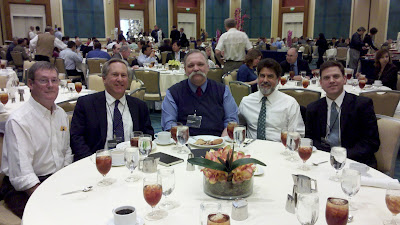 From left: Darrell Galloway, David Hoffman, Pat Iverson, Randy Kincaid.
TMTI's basic initiative is to modernize and speed up the development of vaccines and therapeutics against deadly pathogens, and the swine flu was a perfect way to test its rapid response capabilities. Ironically, it seems the biggest hurdles to rapidity were politics and overzealous DoD bureaucrats concerned with protocol. Eschewing these obstacles, Dr. Galloway decided to take matters into his own hands, and in the end the work was vindicated making TMTI a permanent program at the DoD.
TMTI, how it was used to combat the swine flu and my father were the subjects of a recent article in the New Yorker, called "Going Viral" (Full Article), written by Pulitzer Prize winning author David E. Hoffman. Hoffman's article is well written and it's actually a fun read, without much technical jargon. I could even see it being adapted into a film akin to "Outbreak", or "The Andromeda Strain".
On Tuesday night, April 28, 2009, Darrell Galloway, a senior official at the Pentagon’s Defense Threat Reduction Agency, watched a news report from Mexico City about a new strain of influenza known as swine flu that was spreading fast. That night, Galloway, a microbiologist, resolved to do something about it. He was authorized by the military to work on a specific set of threatening diseases that were considered potential weapons in war or in terrorism, including anthrax, smallpox, plague, and the Ebola and Marburg hemorrhagic fevers. Influenza was outside his focus, but the next morning, Galloway summoned his staff and announced that they were to begin work immediately on creating a new antiviral drug to combat swine flu.I remember that well because at the time I was planning a trip to Mexico City, and he urged me to reconsider. I ended up going anyway, but about a month later instead. Fortunately, I didn't get sick at all, not even with Montezuma's revenge.
From left: Darrell Galloway, David Hoffman, Pat Iverson, Randy Kincaid.
TMTI's basic initiative is to modernize and speed up the development of vaccines and therapeutics against deadly pathogens, and the swine flu was a perfect way to test its rapid response capabilities. Ironically, it seems the biggest hurdles to rapidity were politics and overzealous DoD bureaucrats concerned with protocol. Eschewing these obstacles, Dr. Galloway decided to take matters into his own hands, and in the end the work was vindicated making TMTI a permanent program at the DoD.
In January, 2010, President Obama, in his State of the Union address, promised "a new initiative that will give us the capacity to respond faster and more effectively to bioterrorism or an infectious disease."He did complain about the politics from time to time, but that must have felt good.
Sunday, January 16, 2011
Former ImageMovers Employees Launch Atomic Fiction
via The Hollywood Reporter
The new full-service VFX business will aim to cut costs for clients without sacrificing quality. Three VFX veterans from Robert Zemeckis’ recently shuttered ImageMovers Digital have launched a new facility in Emeryville, Calif.I found this part especially interesting (Kevin told me they're utilizing Amazon EC2):
Named Atomic Fiction, the business was co-founded by Kevin Baillie, who serves as president and VFX supervisor; Ryan Tudhope, creative director and VFX supervisor; and Jenn Emberly, performance and animation supervisor. At ImageMovers, Baillie, Tudhope and Emberly served as VFX supervisor, digital FX supervisor and performance supervisor, respectively.
“We’re trying to find smart ways to do things less expensively,” Baillie said. “We are looking at cloud computing for rendering so that we pay for it as a service, pay as you go.”I think it's great the AF is trying to innovate in a market where many producers are chasing subsidies and tax incentives. I think the best way to stay competitive in the VFX market these days, especially in California, is through real innovation.
Using Emeryville as its data center, the company also is considering the use of satellite bases in areas such as in Louisiana or Vancouver, where it can benefit from financial incentives.Obviously, Vancouver is a major industry hub these days, but Louisiana could be next. Pixel Magic recently opened a branch in Louisiana and Huck Wirtz is basing his startup Bayou FX there as well. Apparently, Louisiana offers some great tax incentives in addition to LITE being in Lafayette.
Monday, November 8, 2010
The November page of my "Scotland by Rail" calendar

The November page of my "Scotland by Rail" calendar, a gift from a colleague at IMD.
by Norman Wilkinson, 1927
London, Midland & Scottish Railway poster.
Tuesday, October 26, 2010
Ebenosferatu

My ImageMovers Digital art contest entry, a spoof of Ebenezer Scrooge from IMD's production of "A Christmas Carol" and this real DVD.
I always thought Scrooge kinda looked like Nosferatu.
Friday, October 22, 2010
Tuesday, October 19, 2010
The "Advertising" Network
Facebook, and the recent film, would be more appropriately called "The Advertising Network". Zuckerberg et al have found a way to "sucker" (his word) people into providing private data to their network of advertisers and third party application developers, all wrapped up in the pretty bow of a "Social Network".
Facebook's purpose is to entice ignorant users into freely giving up their private data, playing on human nature in exchange for short term satisfaction, it's akin to engineering addiction.
How many 'mock outrage' responses from Facebook in the face of an ever-increasing number of privacy breaches will it take before people realize that their motivations are unethical? Why is no one suggesting the simple solution of JUST NOT USING IT? Privacy issues aside, people's data is a commodity. Why would anyone give it away for free?
Tuesday, September 21, 2010
The Rendering Killer (dot com)
via CGTalk
It'll be interesting to see where this goes:
FTA: "We felt it was important for us to be able to communicate our most wild ideas with the greatest simplicity, but it was a mistake to believe that 3D design studios would give us an easier life. So, several years ago, we decided to fill in what we felt was missing from those software dedicated to 3D design and architectural communication, and gave birth to Twinmotion."
Friday, August 27, 2010
Star Wars, The ASCII Version
www.asciimation.co.nz presents

telnet towel.blinkenli
Original Work : Simon Jansen
Telnetification : Sten Spans
Terminal Tricks : Mike Edwards
Thursday, August 5, 2010
George Lucas Among 40 Billionaires to Donate Half Their Money
Forty US billionaires pledged today (Wednesday) to give at least half of their wealth to charity, either during their lifetimes or after death. This will be huge boost to nonprofit company, which suffered from the economic downturn.
The list of those taking the pledge includes Bill Gates, Warren Buffett, T. Boone Pickens, Michael Bloomberg and George Lucas, the man behind "Star Wars" and "Indiana Jones" movies who is said to be worth $3.5 billion. Lucas is the only person in Hollywood to do this.
The pledge idea came about in a series of private meetings that Gates, Buffett and other philanthropists had over the past year on the future of charitable giving. Bloomberg, like several others on the list, said he made the pledge because he has more money than he could ever use himself.
I wonder if he'll dontate any of that fortune to the VFX teams at ILM and Lucasfilm that helped him make that fortune in the first place, like Keanu Reeves did.
Source:
http://www.worstpreviews.com/headline.php?id=18550
The list of those taking the pledge includes Bill Gates, Warren Buffett, T. Boone Pickens, Michael Bloomberg and George Lucas, the man behind "Star Wars" and "Indiana Jones" movies who is said to be worth $3.5 billion. Lucas is the only person in Hollywood to do this.
The pledge idea came about in a series of private meetings that Gates, Buffett and other philanthropists had over the past year on the future of charitable giving. Bloomberg, like several others on the list, said he made the pledge because he has more money than he could ever use himself.
I wonder if he'll dontate any of that fortune to the VFX teams at ILM and Lucasfilm that helped him make that fortune in the first place, like Keanu Reeves did.
Source:
http://www.worstpreviews.com/headline.php?id=18550
Sunday, July 4, 2010
Irish Pipers - Fourth of July 2010
An Irish piper band "rehydrating" at FInnegan's during the 2010 Fourth of July parade in downtown Novato playing "Dawn of the Day". Apologies for the crappy quality but my iphone couldn't handle all of the awesomeness.
Monday, June 21, 2010
Google Command Line
Google Command Line: "Ever wanted to upload a folder full of photos to Picasa from a command prompt? We did, a lot, last summer. It made us want to say:
So we wrote a program to do that, and a whole lot more.
GoogleCL is a command-line utility that provides access to various Google services. It streamlines tasks such as posting to a Blogger blog, adding events to Calendar, or editing documents on Google Docs.
For example:
GoogleCL is a pure Python application that uses the Python gdata libraries to make Google Data API calls from the command line."
$ google picasa create --title 'My album' ~/Photos/vacation/*.jpg So we wrote a program to do that, and a whole lot more.
GoogleCL is a command-line utility that provides access to various Google services. It streamlines tasks such as posting to a Blogger blog, adding events to Calendar, or editing documents on Google Docs.
For example:
$ google blogger post --blog 'My blog' --tags 'python, googlecl, development' my_post.html $ google calendar add 'Lunch with Jason tomorrow at noon'$ google docs edit --title 'Shopping list' --editor vimGoogleCL is a pure Python application that uses the Python gdata libraries to make Google Data API calls from the command line."
Tuesday, June 8, 2010
A Conversation with Dennis Muren
A Conversation with Dennis Muren:

The A List Series presents conversations
with Authors, Artists, Athletes Adventurers, Academics and Anarchists
Star Wars, Wall-E and Human Nature:
The Unconventional Mind of a Special Effects Genius
A Conversation with Dennis Muren
Interviewed by Joan Ryan
Wednesday, June 16 7:30pm
$15.00 General Admission, $12.00 Students/Seniors
Buy tickets or call 415.383.9600
Dennis Muren has nine Oscars on his mantle, winning Best Achievement in Visual Effects for such movies as Indiana Jones and the Temple of Doom, The Empire Strikes Back, E.T., and Jurassic Park. He is the first visual effects artist to be honored with a Star on the Hollywood Walk of Fame. His work takes our breath away. But his genius is less about technology and more about the art of observation. Muren’s stunning, other-worldly creations come from a very earthly understanding of storytelling and human nature. He is the Senior Visual Effects Supervisor at Industrial Light & Magic, and he is currently finishing a book on “Inspiration & Observation’’ for computer artists. Joan Ryan is an award-winning journalist and author. Her most recent book is “The Water Giver: The Story of a Mother, a Son and Their Second Chance,’’ a memoir published by Simon & Schuster in 2009. Ryan was a pioneer in sports journalism, becoming one of the first female sports columnists in the country. She then went on to writing op-ed columns and city columns for the San Francisco Chronicle. Her first book, “Little Girls in Pretty Boxes: The Making and Breaking of Elite Gymnasts and Figure Skaters’’ (1995, Doubleday) was a controversial, ground-breaking expose that Sports Illustrated named one of the “Top 100 Sports Books of All Time.’’ The A List Series presents conversations with Authors, Artists, Athletes, Adventurers, Academics and Anarchists. |
MARS!
Great short film by Joe Bichard and Jack Cunningham. Umm…drill, baby, drill?
MARS! from Joe Bichard on Vimeo.
Subscribe to:
Posts (Atom)